Michael Holtzapfel
The Book ThiefMichael Holtzapfel is a young German soldier whose return to Himmel Street transforms an apparently distant military disaster into an intimate domestic catastrophe. Introduced with a bandaged hand and a face marked by pain, he carries news of his brother’s death from Stalingrad and later dies by suicide, overwhelmed by the guilt of having survived. His brief presence gives the novel one of its starkest accounts of how war continues after a soldier has physically come home.
Identity and Return
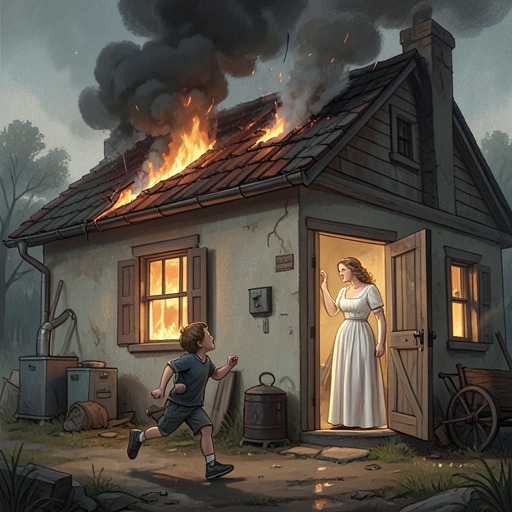
Michael first appears in January 1943, in the dark winter corridor of Himmel Street. Liesel Meminger goes to Frau Holtzapfel’s door expecting to encounter one of the family’s sons, but the man who answers seems older than either brother as shown in the framed photographs. Whiskers obscure his face, his eyes appear painfully expressive, and a bandaged hand hangs from his coat sleeve while blood seeps through the wrapping. His body announces that the battlefield has followed him home before he has explained anything about it.
He is also connected to Liesel through reading. After showing her how to light and smoke a cigarette in the freezing weather, he identifies himself as Michael Holtzapfel when he takes the cigarette back with his uninjured left hand. Liesel gives her own name, and he immediately recognizes the purpose of her visit: she has come to read to his mother. This exchange places him within the ordinary network of Himmel Street, even as his injury marks him as someone returned from an extraordinary and destructive world.
The News from Stalingrad
Michael’s decisive revelation is that his brother is dead. He tells Rosa Hubermann that the brother died after being brought to a building being used as a hospital. Michael had been due to return home within a week, but spent three days sitting beside him before he died. The account is delivered with controlled precision, yet its effect is devastating: Rosa staggers under the news because she had watched both Holtzapfel boys grow up.
The death is linked to the snows of Stalingrad, where the war’s political abstractions become damaged bodies and bereaved families. Michael’s bandaged hand is one visible remnant of the campaign; his brother’s death is another, more irreversible wound. The scene also exposes the gap between public language and private reality. The Führer’s war may present sacrifice as patriotic achievement, but Michael returns with a dead brother, an injured body, and no language capable of making either loss meaningful.
Trauma and Survivor’s Guilt
Michael’s suffering does not end when he reaches home. The later account of his death explains that he is worn down not primarily by his damaged hand or another physical injury, but by the guilt of living. He cannot sleep, and each night becomes poisonous. His trauma returns through imagined visions of his brother’s severed legs, making memory an involuntary repetition rather than a completed past.
Liesel recognizes the possibility of telling Michael about her own brother, as she had told Max Vandenburg, but she also understands the difference between the two losses. Her brother died during the journey that brought her to Himmel Street; Michael’s brother died after the destruction of war had passed through his body and remained in his sight. The distinction leaves her unsure how consolation could work. Instead of offering a ready explanation, she can only allow Michael to speak. His suffering demonstrates the limits of sympathy when experience has become physically and morally unbearable.
Death and the Last Goodbye
In July 1943, Michael dies by hanging in a laundry near Frau Diller’s. The narrative fixes the moment with the stark heading “JULY 24, 6:03 A.M.” and describes the laundry as warm, with firm rafters, details that make the act chillingly concrete. His death follows the return of soldiers and the intensification of suffering on Himmel Street, where the pursuit of Russia has produced consequences that cannot be confined to the front.
The narration emphasizes that Michael’s death is discovered after the fact. The account reaches the reader through Liesel’s later writing in The Book Thief, which records the letter he left for his mother. His most important words therefore arrive belatedly, after he is no longer able to participate in the life around him. The letter becomes his final attempt to speak across the silence created by suicide, war, and the inability of those around him to reach the depth of his guilt.
Narrative and Thematic Significance
Michael’s trajectory moves from physical return to psychological disappearance. At first, his injured hand and bloodied bandage make his suffering visible; later, sleeplessness, guilt, and visions reveal a wound that cannot be dressed. His story contrasts the public identity of the returned soldier with the private reality of a survivor who experiences continued life as an accusation.
He also extends the novel’s wider concern with labels and historical identities. The book shows how people are classified as German, Jewish, communist, soldier, or civilian, while the consequences of those categories are lived by singular bodies and families. The persecution of Jews and the war against Russia are not separate moral worlds: the starving prisoners seen on Munich Street and Michael’s ruined family belong to the same system of violence. Through Michael, the novel refuses to let military death remain an impersonal statistic. Stalingrad is carried back into Himmel Street as a hand, a memory, a mother’s grief, and a final letter.